ThreadLocal 介绍
概述
ThreadLocal 是 java 提供的一个方便对象在本线程内不同方法中传递和获取的类。用它定义的变量,仅在本线程中可见和维护,不受其他线程的影响,与其他线程相互隔离。
虽然在本线程不同方法中使用变量,可以通过在方法中传入参数解决,但是当涉及多个方法甚至多个类时,为每个方法增加同样的参数将是一场噩梦,此时 ThreadLocal 就能很好地解决这个问题。它可以在本线程内任何一个地方赋值,在任何一个地方获取值,并且不用作为函数参数传入。这看起来像静态成员变量,但是 ThreadLocal 变量相比静态成员变量的一个优势就是, ThreadLocal 是线程隔离的,其值不会受另一个线程的影响,也不用考虑加锁或值被其他线程篡改的问题,而这些问题都是静态成员变量无法做到的。因此当涉及一个对象需要在很多不同方法之间传递时,应该考虑使用 ThreadLocal 对象来简化代码。
使用
ThreadLocal 通过 set 方法可以给变量赋值,通过 get 方法获取变量的值。当然,也可以在定义变量时通过 ThreadLocal.withInitial 方法给变量赋初始值,或者定义一个继承 ThreadLocal 的类,然后重写 initialValue 方法。
示例代码如下
public class TestThreadLocal
{
    private static ThreadLocal<StringBuilder> builder = ThreadLocal.withInitial(StringBuilder::new);

    public static void main(String[] args)
    {
        for (int i = 0; i < 5; i++)
        {
            new Thread(() -> {
                String threadName = Thread.currentThread().getName();
                for (int j = 0; j < 3; j++)
                {
                    append(j);
                    System.out.printf("%s append %d, now builder value is %s, ThreadLocal instance hashcode is %d, ThreadLocal instance mapping value hashcode is %d/n", threadName, j, builder.get().toString(), builder.hashCode(), builder.get().hashCode());
                }

                change();
                System.out.printf("%s set new stringbuilder, now builder value is %s, ThreadLocal instance hashcode is %d, ThreadLocal instance mapping value hashcode is %d/n", threadName, builder.get().toString(), builder.hashCode(), builder.get().hashCode());
            }, "thread-" + i).start();
        }
    }

    private static void append(int num) {
        builder.get().append(num);
    }

    private static void change() {
        StringBuilder newStringBuilder = new StringBuilder("HelloWorld");
        builder.set(newStringBuilder);
    }
}
在例子中,定义了一个 builder 的 ThreadLocal 对象,然后启动 5 个线程,分别对 builder 对象进行访问和修改操作,这两个操作放在两个不同的函数 append 、 change 中进行,两个函数访问 builder 对象也是直接获取,而不是放入函数的入参中传递进来。
代码输出如下
thread-0 append 0, now builder value is 0, ThreadLocal instance hashcode is 796465865, ThreadLocal instance mapping value hashcode is 566157654
thread-0 append 1, now builder value is 01, ThreadLocal instance hashcode is 796465865, ThreadLocal instance mapping value hashcode is 566157654
thread-4 append 0, now builder value is 0, ThreadLocal instance hashcode is 796465865, ThreadLocal instance mapping value hashcode is 654647086
thread-3 append 0, now builder value is 0, ThreadLocal instance hashcode is 796465865, ThreadLocal instance mapping value hashcode is 1803363945
thread-2 append 0, now builder value is 0, ThreadLocal instance hashcode is 796465865, ThreadLocal instance mapping value hashcode is 1535812498
thread-1 append 0, now builder value is 0, ThreadLocal instance hashcode is 796465865, ThreadLocal instance mapping value hashcode is 2075237830
thread-2 append 1, now builder value is 01, ThreadLocal instance hashcode is 796465865, ThreadLocal instance mapping value hashcode is 1535812498
thread-3 append 1, now builder value is 01, ThreadLocal instance hashcode is 796465865, ThreadLocal instance mapping value hashcode is 1803363945
thread-4 append 1, now builder value is 01, ThreadLocal instance hashcode is 796465865, ThreadLocal instance mapping value hashcode is 654647086
thread-0 append 2, now builder value is 012, ThreadLocal instance hashcode is 796465865, ThreadLocal instance mapping value hashcode is 566157654
thread-0 set new stringbuilder, now builder value is HelloWorld, ThreadLocal instance hashcode is 796465865, ThreadLocal instance mapping value hashcode is 1773033190
thread-4 append 2, now builder value is 012, ThreadLocal instance hashcode is 796465865, ThreadLocal instance mapping value hashcode is 654647086
thread-4 set new stringbuilder, now builder value is HelloWorld, ThreadLocal instance hashcode is 796465865, ThreadLocal instance mapping value hashcode is 700642750
thread-3 append 2, now builder value is 012, ThreadLocal instance hashcode is 796465865, ThreadLocal instance mapping value hashcode is 1803363945
thread-3 set new stringbuilder, now builder value is HelloWorld, ThreadLocal instance hashcode is 796465865, ThreadLocal instance mapping value hashcode is 1706743158
thread-2 append 2, now builder value is 012, ThreadLocal instance hashcode is 796465865, ThreadLocal instance mapping value hashcode is 1535812498
thread-2 set new stringbuilder, now builder value is HelloWorld, ThreadLocal instance hashcode is 796465865, ThreadLocal instance mapping value hashcode is 1431127699
thread-1 append 1, now builder value is 01, ThreadLocal instance hashcode is 796465865, ThreadLocal instance mapping value hashcode is 2075237830
thread-1 append 2, now builder value is 012, ThreadLocal instance hashcode is 796465865, ThreadLocal instance mapping value hashcode is 2075237830
thread-1 set new stringbuilder, now builder value is HelloWorld, ThreadLocal instance hashcode is 796465865, ThreadLocal instance mapping value hashcode is 1970695360
从输出中 1~6 行可以看出,不同线程访问的是同一个 builder 对象(不同线程输出的 ThreadLocal instance hashcode 值相同),但是每个线程获得的 builder 对象存储的实例 StringBuilder 不同(不同线程输出的 ThreadLocal instance mapping value hashcode 值不相同)。
从输出中 1~2 、 9~10 行可以看出,同一个线程中修改 builder 对象存储的实例的值时,并不会影响到其他线程的 builder 对象存储的实例( thread-4 线程改变存储的 StringBuilder 的值并不会引起 thread-0 线程的 ThreadLocal instance mapping value hashcode 值发生改变)
从输出中 9~13 行可以看出,一个线程对 ThreadLocal 对象存储的值发生改变时,并不会影响其他的线程( thread-0 线程调用 set 方法改变本线程 ThreadLocal 存储的对象值,本线程的 ThreadLocal instance mapping value hashcode 发生改变,但是 thread-4 的 ThreadLocal instance mapping value hashcode 并没有因此改变)。
原理
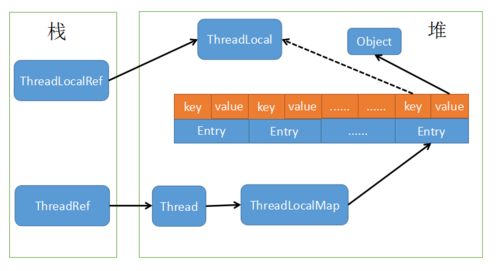
ThreadLocal 能在每个线程间进行隔离,其主要是靠在每个 Thread 对象中维护一个 ThreadLocalMap 来实现的。因为是线程中的对象,所以对其他线程不可见,从而达到隔离的目的。那为什么是一个 Map 结构呢。主要是因为一个线程中可能有多个 ThreadLocal 对象,这就需要一个集合来进行存储区分,而用 Map 可以更快地查找到相关的对象。
ThreadLocalMap 是 ThreadLocal 对象的一个静态内部类,内部维护一个 Entry 数组,实现类似 Map 的 get 和 put 等操作,为简单起见,可以将其看做是一个 Map ,其中 key 是 ThreadLocal 实例, value 是 ThreadLocal 实例对象存储的值。
set
当调用 ThreadLocal 的 set 方法给变量设置值时, ThreadLocal 对象会先获取本线程的 ThreadLocalMap 对象,然后将当前的 ThreadLocal 对象及要设置值作为键值对放入 Map 中。
public void set(T value) {
    Thread t = Thread.currentThread();
    // 获取当前线程的 ThreadLocalMap 对象
    ThreadLocalMap map = getMap(t);
    if (map != null)
        // this 指当前的 ThreadLocal 对象
        map.set(this, value);
    else
        // key 不存在,则创建 map 并设置值
        createMap(t, value);
}

ThreadLocalMap getMap(Thread t) {
    // threadLocals 是 Thread 中的一个变量,因此是线程隔离的,不会受其他线程影响
    // 其在 Thread 类中的定义如下:ThreadLocal.ThreadLocalMap threadLocals = null;
    return t.threadLocals;
}
get
获取 ThreadLocal 存储的对象值时,需要调用 get 方法。此方法也是先获取本线程的 ThreadLocalMap 对象,然后将当前的 ThreadLocal 对象作为 key 从 Map 中获取对应的值,如果没有,则返回一个初始 null 。
public T get() {
    Thread t = Thread.currentThread();
    // 获取当前线程的 ThreadLocalMap 对象
    ThreadLocalMap map = getMap(t);
    if (map != null) {
        // this 指当前的 ThreadLocal 对象
        ThreadLocalMap.Entry e = map.getEntry(this);
        if (e != null) {
            @SuppressWarnings("unchecked")
            T result = (T)e.value;
            return result;
        }
    }
    return setInitialValue();
}
内存泄漏
ThreadLocalMap 中的 key 是一个 ThreadLocal 对象,且是一个弱引用,而 value 却是一个强引用。
static class ThreadLocalMap {
    /**
      * The entries in this hash map extend WeakReference, using
      * its main ref field as the key (which is always a
      * ThreadLocal object).  Note that null keys (i.e. entry.get()
      * == null) mean that the key is no longer referenced, so the
      * entry can be expunged from table.  Such entries are referred to
      * as "stale entries" in the code that follows.
      */
    static class Entry extends WeakReference<ThreadLocal<?>> {
        /** The value associated with this ThreadLocal. */
        Object value;

        Entry(ThreadLocal<?> k, Object v) {
            super(k);
            value = v;
        }
    }
    // 其他代码
}
毫无疑问,如果线程执行完关闭,那么线程的所有对象都会被销毁,此时不会存在内存泄漏的问题。此外,在执行 get 、 set 操作时,调用进入 ThreadLocalMap 内部的函数,会对 Entry 进行检查,如果 key 为空,也会将 value 设置为空,让其可以被垃圾回收。所以一般情况下也不会造成内存泄漏。
// get 或 set 方法,满足一定条件时会进入 expungeStaleEntry 方法
// 此方法内部会将 key 为 null 的 Entry 的 value 设置为 null,从而使得其可以被垃圾回收
private int expungeStaleEntry(int staleSlot) {
    Entry[] tab = table;
    int len = tab.length;

    // 设置 value 值为 null,清空引用,让其可以被 GC 回收
    // expunge entry at staleSlot
    tab[staleSlot].value = null;
    tab[staleSlot] = null;
    size--;

    // Rehash until we encounter null
    Entry e;
    int i;
    for (i = nextIndex(staleSlot, len);
         (e = tab[i]) != null;
         i = nextIndex(i, len)) {
        ThreadLocal<?> k = e.get();
        if (k == null) {
            // 设置 value 值为 null,清空引用,让其可以被 GC 回收
            e.value = null;
            tab[i] = null;
            size--;
        } else {
            int h = k.threadLocalHashCode & (len - 1);
            if (h != i) {
                tab[i] = null;

                // Unlike Knuth 6.4 Algorithm R, we must scan until
                // null because multiple entries could have been stale.
                while (tab[h] != null)
                    h = nextIndex(h, len);
                tab[h] = e;
            }
        }
    }
    return i;
}
但是,存在一种情况,可能导致内存泄漏。如果在某一时刻,将 ThreadLocal 实例设置为 null ,即没有 ThreadLocal 没有强引用了,如果发生 GC 时,由于 ThreadLocal 实例只存在弱引用,所以被回收了,但是 value 仍然存在一个当前线程连接过来的强引用,其不会被回收,只有等到线程结束死亡或者手动清空 value 或者等到另一个 ThreadLocal 对象进行 get 或 set 操作时刚好触发 expungeStaleEntry 函数并且刚好能够检查到本 ThreadLocal 对象 key 为空(概率太小),这样才不会发生内存泄漏。否则, value 始终有引用指向它,它也不会被 GC 回收,那么就会导致内存泄漏。虽然发生内存泄漏的概率比较小,但是为了保险起见,也建议在使用完 ThreadLocal 对象后调用一下 remove 方法清理一下值。
与线程池结合使用
由于线程池是会复用线程的,因此如果在线程任务中对 ThreadLocal 没有经过重新设值而直接读取值的话,可能读取到的是该线程上一个任务赋值的结果,而不是本次任务的初始值,从而导致一些意向不到的错误。如下所示,创建一个固定大小是 3 的线程池,但是往线程池中放入 5 个任务,则最后两个任务会复用之前创建的线程,此时调用 ThreadLocal 的 get 方法获取到的是上一个任务赋值的结果,而不是本线程的初始值(程序输出的第 4~5 行就是复用了线程 11 和 13 ,第一次获取到的是也是上一个任务赋的值 2 ,而不是本线程的初始值 1 )。
public class TestThreadLocalExecutor
{
    private static ThreadLocal<Integer> id = ThreadLocal.withInitial(() -> 1);

    public static void main(String[] args)
    {
        ExecutorService executor = Executors.newFixedThreadPool(3);
        for (int i = 0; i < 5; i++)
        {
            executor.execute(() -> {
                long threadId = Thread.currentThread().getId();
                // 任务开始时重新赋值,否则可能读取到的是上一个任务的值
                // id.set(1);
                int before = id.get();
                increment();
                int after = id.get();

                System.out.printf("Thread id: %d, before increment: %d, after increment: %d/n", threadId, before, after);
            });
        }

        executor.shutdown();
    }

    private static void increment()
    {
        int result = id.get() + 1;
        id.set(result);
    }
}
程序输出如下
Thread id: 11, before increment: 1, after increment: 2
Thread id: 13, before increment: 1, after increment: 2
Thread id: 12, before increment: 1, after increment: 2
Thread id: 13, before increment: 2, after increment: 3
Thread id: 11, before increment: 2, after increment: 3
为了避免如上情况的发生,可以在每个任务开始时,为 ThreadLocal 对象重新设置初始值(在 get 方法前先调用 set 方法),或者使用原生的创建线程的方式(跳开线程池的方式)。
正文到此结束
热门推荐





相关文章



Loading...